ECObyRy: Making a Better Board From What We Already Have
A closer look at recycled materials, waste reduction, and one surfboard maker trying to leave less behind
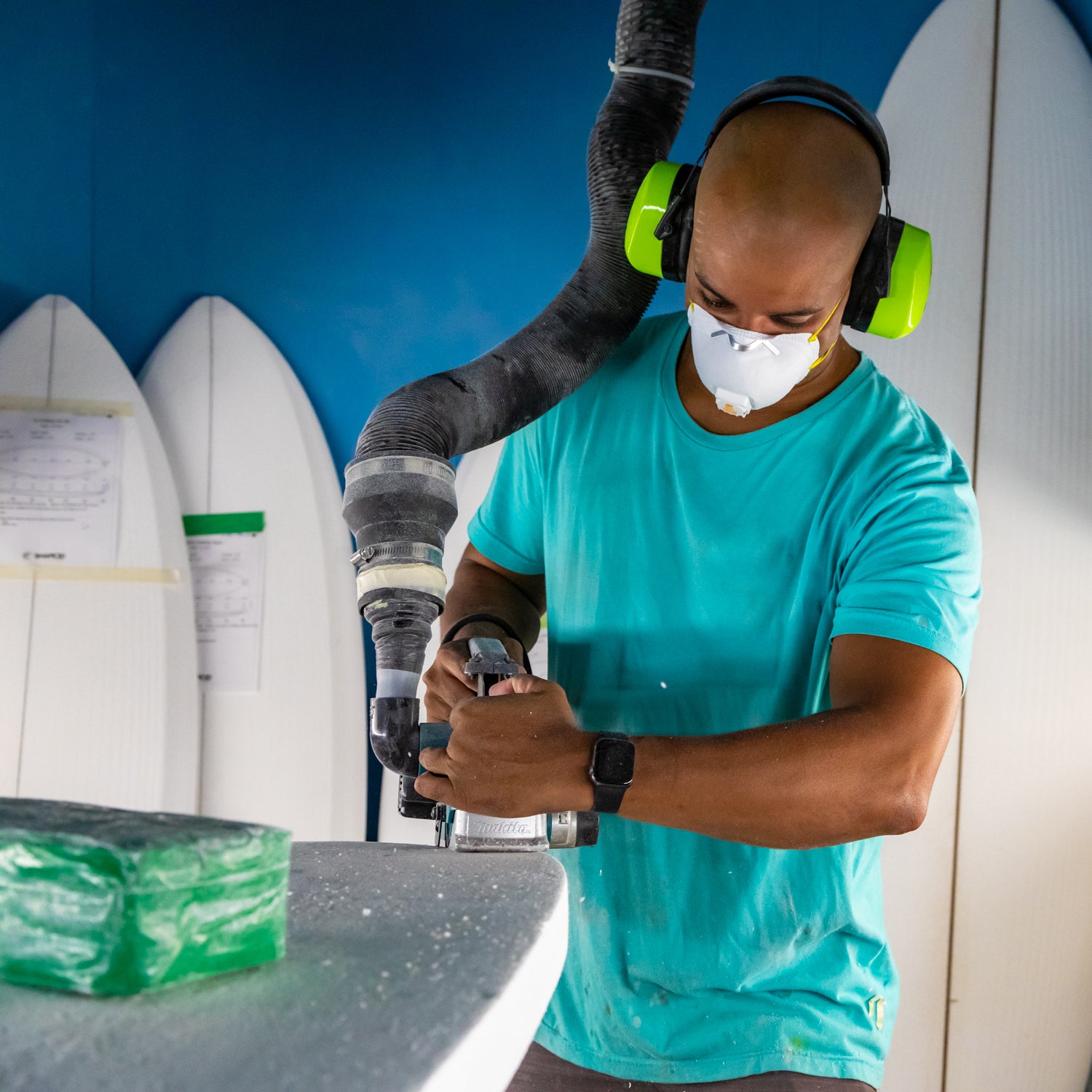
Surfing depends on the ocean.
However, surfboards have not always been especially kind to it.
Conventional surfboard construction commonly relies on foams, resins, fiberglass, energy, and materials that are difficult to recover once their useful life is over. That creates an obvious tension for a sport built around the natural world.
Ryan Harris appears to have spent years asking a simple question:
Can we make the board differently?
Today, that work continues through ECObyRy. California records identify ECObyRy Corp. as a California sporting-goods corporation and lists Harris as CEO, CFO, Secretary, and the sole listed director. [1]
But the interesting part is not the paperwork.
It is what he is doing with the materials.
Start With the Waste
The most compelling part of ECObyRy’s work may be its willingness to look at material that would normally be treated as waste and ask whether it still has a useful life.
The company traces its roots through Harris’s earlier Earth Technologies / EarthTech Surf work. Its own history describes years of experimenting with recycled EPS foam, bio-based epoxy, sustainably sourced veneers, alternative reinforcement materials, and production-waste reuse. In 2018, Harris launched what the company calls its Zero Waste Initiative, separating waste streams, returning EPS offcuts for recycling, and finding secondary uses for other manufacturing waste. [2]
The principle is simple enough:
If useful material already exists, why immediately reach for more new material?
That does not erase the impact of producing a surfboard. A new board still requires raw materials, energy, transportation, and eventually an end-of-life decision.
But progress does not require every impact to disappear before it counts.
Sometimes progress is taking material that would have been discarded and finding another use for it. That appears to be a meaningful part of what ECObyRy is trying to do.
A Different Kind of Construction
ECObyRy also uses materials intended to lower the impact of the board itself, including recycled-content EPS blanks and Entropy Resins’ Super Sap bio-based epoxy systems. The company also describes the use of wood veneers, plant-based reinforcement materials, and basalt fiber in some constructions. [3]
The phrase bio-based deserves some care. It does not mean impact-free, and it does not mean petroleum disappears completely.
It means that part of the resin’s carbon content comes from biological feedstocks rather than exclusively fossil-derived sources. Sustainable Surf currently lists multiple Super Sap systems at roughly 29–30% bio-carbon content in the fully cured resin, with those systems qualifying for its ECOBOARD standards. [4]
The important question is whether that materially changes the footprint.
There is evidence that it can.
A lifecycle study commissioned through Sustainable Surf compared a conventional polyurethane/polyester surfboard with an ECOBOARD built using Super Sap bio-epoxy and an EPS blank containing 25% recycled content. The ECOBOARD construction showed about a 30% reduction in carbon footprint in that comparison. [5]
That does not mean every ECObyRy board is automatically 30% lower-carbon.
It tells us something more useful:
The construction strategy itself has substance behind it.
This is not simply a greener label placed on the same old product. Changing the materials can meaningfully change the footprint.
When the Scraps Become the Product
This is where Harris’s work becomes especially interesting.
Environmental improvement is often framed as buying the right new thing.
ECObyRy’s work points toward another possibility:
Use more of what already exists.
The company’s Zero Waste Initiative describes sorting production waste, recycling EPS blank offcuts, shredding cured manufacturing waste, and turning some of that material into other products. [6]
That approach has continued beyond the factory scraps themselves.
AltaSea at the Port of Los Angeles featured Harris in its 2026 ReUp Our Ocean program, describing his work turning recovered ocean-bound plastic into functional surfboard fins and other upcycled products. [7]
That matters because waste does not disappear when it leaves the workshop.
It only goes somewhere else.
Reusing material does not solve every problem associated with plastics or composite manufacturing, but it changes what happens next.
Instead of: make → use → discard
the question becomes:
what can this become now?
That is a small language change.
And it can be a large change in practice.
Lower Impact Doesn’t Mean No Impact
We should still be careful with words like sustainable, eco-friendly, and zero waste.
Those words can become so broad that they stop telling us much.
A surfboard made with recycled material still has an environmental footprint. Bio-based resin still has an environmental footprint. Recycling requires energy and infrastructure. Composite products can remain difficult to recover at end of life.
So I would rather describe what ECObyRy appears to be doing more plainly:
lower-impact surfboard construction and active material reuse.
That is less dramatic than calling a product sustainable.
It is also easier to defend.
And I think it better honors the work.
The story is not that someone has created a perfect surfboard.
It is that someone is looking at the imperfect materials available to the industry and asking how much better they can be used.
Performance Still Matters
None of this matters very much if the finished board is poor at being a surfboard. A product that fails quickly can simply create another kind of waste.
That is why durability, repairability, performance, and useful life still belong in the conversation. ECObyRy does not appear to treat lower-impact construction as a novelty line. Its current site presents performance shortboards, longboards, SUPs, foil boards, alternative construction technologies, and custom builds. Its materials are intended for structural composite use, and Sustainable Surf’s ECOBOARD criteria specifically require qualifying materials to reduce environmental impact without sacrificing performance, durability, or quality. [3, 8]
Independent long-term performance data on ECObyRy’s full current lineup is still limited.
But that does not erase what is already visible.
The company appears to be trying to make the environmental improvement part of a product surfers genuinely want to use.
That is the harder goal.
And it is the more meaningful one.
What We See
There is a temptation in consumer research to look only for reasons something falls short.
That matters.
But discernment should also be able to recognize something good when it finds it.
What we see in ECObyRy is a small manufacturer experimenting with ways to use fewer virgin inputs, redirect production waste, reclaim material, and improve a product category that has historically carried environmental costs.
Sustainable Surf has repeatedly featured Harris and ECObyRy in its ECOBOARD work, including a 2024 shaper profile focused on his lower-impact manufacturing and zero-waste efforts. [9]
Not every good practice means every product is automatically worthy of purchase.
And a company does not need to be perfect before anything it does can be worth noticing.
The work itself can still bear good fruit.
ECObyRy appears to be taking material that might otherwise become part of the mess and asking whether it can become something useful instead.
That is worth bringing into the light.
Our Current Read
ECObyRy is not interesting because it has solved sustainable surfboard manufacturing.
It is interesting because it appears to be doing the quieter work of making an imperfect product category better.
Recycled-content materials. Bio-based resin systems. Production-waste reuse. Recovered plastics finding another purpose. A willingness to keep experimenting.
Those things do not erase every environmental cost of a surfboard.
But they do show that those costs do not have to be accepted as fixed.
That is the kind of work The Good Fruit wants to notice.
Not because good intentions excuse weak products.
Not because environmental language should be accepted without examination.
But because when someone is trying to use what already exists more wisely, reduce what gets thrown away, and make something useful from what others might discard, there is something there worth recognizing.
Good fruit does not require perfect fruit.
Sometimes it looks like taking what is already in our hands and finding a better way to use it.
Sources & Bibliography
Note: The article keeps source markers light for readability. The accompanying TGF Research & Evidence Record contains the fuller audit trail, source classification, unresolved questions, and research notes.
[1] California Secretary of State. Statement of Information — ECObyRy Corp., Entity No. 5678255, filed May 2, 2023.
[2] ECObyRy. “About Ry Harris Shapes.” Company history, materials, Zero Waste Initiative, and transition from Earth Technologies / EarthTech Surf to ECObyRy. https://ecobyry.com/pages/about-us
[3] ECObyRy. “Tech.” Construction methods and materials, including recycled EPS, Super Sap bio-based epoxy, wood veneers, plant-based reinforcement, and basalt. https://ecobyry.com/pages/tech
[4] Sustainable Surf — The ECOBOARD Project. “Qualified Materials.” Bio-carbon and recycled-content requirements for qualifying surfboard materials, including Super Sap systems. https://ecoboard.sustainablesurf.org/qualified-materials/
[5] Sustainable Surf — The ECOBOARD Project. “Lifecycle Analysis.” Comparative lifecycle assessment reporting approximately 30% lower carbon footprint for the tested ECOBOARD construction. https://ecoboard.sustainablesurf.org/lifecycle-analysis/
[6] ECObyRy. “The Zero Waste Initiative.” Production-waste sorting, EPS recycling, shredding, and upcycling practices. https://ecobyry.com/pages/zero-waste-greenlines
[7] AltaSea at the Port of Los Angeles. “ReUp Our Ocean.” Program featuring Ryan Harris’s use of recovered plastic in surfboard fins and other upcycled products. https://altasea.org/event/altasea-open-house-reup-our-ocean/
[8] Sustainable Surf — The ECOBOARD Project. “Qualified Criteria.” ECOBOARD criteria addressing environmental impact while maintaining performance, durability, and quality. https://ecoboard.sustainablesurf.org/qualified-criteria/
[9] Sustainable Surf — The ECOBOARD Project. “EcoByRy: ESS09.” 2024 shaper profile of Ryan Harris and ECObyRy. https://ecoboard.sustainablesurf.org/slider/ecoboard-shaper-highlight-009/
Evidence Record
The supporting document behind this article, kept on file for full transparency. ECObyRy Research_Evidence_Record_v1.0_Final.docx.pdf
View evidence record